


Send Meeting In Progress
Last updated: Oct 15, 2026
You are here: Correct → Meeting in Progress MEET. Not sure why this action is needed? Go back to Data Monitoring Help. After the reporting archive is created, continue through Submit and Verify as needed.
Use Meeting in Progress only after the meeting actually happened.
Use this special archive when the meeting occurred, but it probably will not be finalized before the LEA wants to LEA Approve/certify its CALPADS reporting. If you are not sure whether Meeting in Progress, Pending As Of, or neither applies, start with Pending in SIRAS: Know Which "Pending" You Mean.
Use this special archive when the meeting occurred, but it probably will not be finalized before the LEA wants to LEA Approve/certify its CALPADS reporting. If you are not sure whether Meeting in Progress, Pending As Of, or neither applies, start with Pending in SIRAS: Know Which "Pending" You Mean.
SIRAS click path: Student Info → MIS Summary → Archive for Reporting → Meeting in Progress
What this record means:
A Meeting in Progress archive reports the MEET for a meeting that already occurred when normal meeting finalization will not happen soon enough for the LEA's intended certification timing. It is not a routine substitute for finalizing an open meeting.
A Meeting in Progress archive reports the MEET for a meeting that already occurred when normal meeting finalization will not happen soon enough for the LEA's intended certification timing. It is not a routine substitute for finalizing an open meeting.
Use This Procedure When
| Check | Required condition |
|---|---|
| Meeting occurred | The actual meeting has already happened. The meeting date is today or earlier. |
| Reporting need | The LEA needs the MEET reflected before it plans to LEA Approve/certify. |
| Finalization timing | The meeting probably will not be finalized soon enough for that LEA Approve/certification timing. |
Do not use Meeting in Progress just because finalization is taking longer than expected.
If the meeting can reasonably be finalized before the LEA wants to LEA Approve, finalize it normally and let the normal reporting workflow create/report the MEET record.
If the meeting can reasonably be finalized before the LEA wants to LEA Approve, finalize it normally and let the normal reporting workflow create/report the MEET record.
Meeting has not happened yet?
Meeting in Progress is not appropriate. Return to the 541 decision flow. If the student is overdue as of the reporting date and the arranged meeting will occur after that date, Pending As Of may be the appropriate path.
Meeting in Progress is not appropriate. Return to the 541 decision flow. If the student is overdue as of the reporting date and the arranged meeting will occur after that date, Pending As Of may be the appropriate path.
Before You Create the Archive
- Confirm the meeting actually occurred.
- Confirm the meeting date entered in SIRAS is the actual meeting date and is today or earlier.
- Confirm the LEA expects that the meeting will not be finalized before its intended LEA Approve/certification timing.
Meeting Held indicator:
The current SIRAS procedure does not require the separate Meeting Held indicator for this archive. The meeting itself must still have occurred, and the actual meeting date must be entered.
The current SIRAS procedure does not require the separate Meeting Held indicator for this archive. The meeting itself must still have occurred, and the actual meeting date must be entered.
Create the Meeting in Progress Archive
- Open the student's MIS Summary.
- Select Archive for Reporting.
- Select Meeting in Progress.
- Confirm the Meeting Date matches the Report Event Date.
- Create/report the archive.
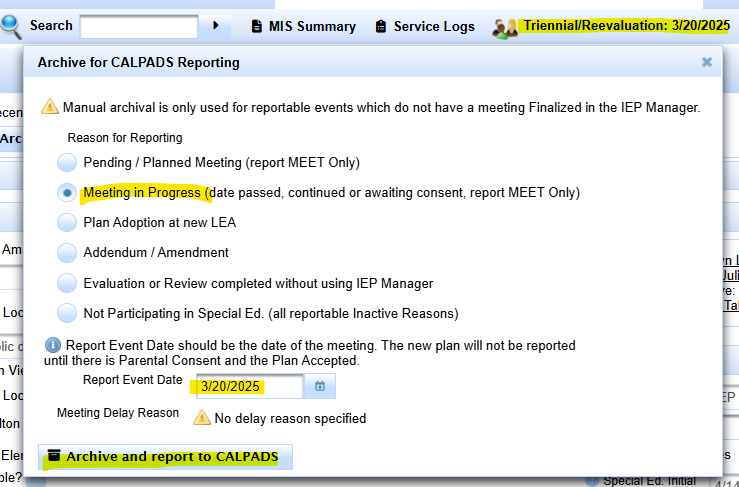
For Meeting in Progress, the meeting has already occurred and the meeting date should match the Report Event Date.
Observable result:
SIRAS creates an archived MEET for the meeting that already happened so the LEA can report that meeting before the full meeting workflow is finalized.
SIRAS creates an archived MEET for the meeting that already happened so the LEA can report that meeting before the full meeting workflow is finalized.
What Happens When the Meeting Is Finalized Later?
Continue and finalize the meeting through the normal SIRAS workflow when the remaining work and parent response are complete. When the parent response supports implementation of the plan, review and report the applicable PLAN and SERV information through the normal finalization/reporting workflow.
Think of the special archive as a timing bridge for the MEET.
It reports that the meeting happened. It does not mean the plan and services were already finalized or accepted.
It reports that the meeting happened. It does not mean the plan and services were already finalized or accepted.
What this action changes
- Found Set: Not applicable.
- View: A dated Meeting in Progress archive becomes available in the student's reporting history.
- Data: Changes student reporting history and can submit the MEET associated with the meeting that already occurred.
- Persistence: Permanent reporting/history change unless corrected through the normal archived-transaction/CALPADS correction process.

