


Use Goals Developer to prepare goals for an upcoming IEP, work with goals that are already Current, or set up inherited goals before progress reporting.
Go to Progress Report Help. Current Goals and Current Progress belong together: progress reporting is tied to the goals in the student's Current IEP.
| Develop goals for an upcoming IEPWork in Goals in Development. Those goals move to Current when the new IEP is finalized and able to take effect. | Add or modify a Current GoalFor an Addendum/Amendment or Other Review, work with the student's Current Goals. |
| Report progress on Current Goals Current Goals and Current Progress are a matched yearly set. Use Progress Report Help for the regular progress-report workflow. | Goals came from an IEP created outside SIRASUse the Show Me workflow when the inherited goals need to be established in SIRAS before progress can be reported. |
Create New Goals for the New IEP
When the team is developing the next IEP, staff should normally create a new goal rather than carry the old goal forward unchanged. There are two primary ways to create that new goal in Goals Developer.
| Create New Goal with GoalWizard Use GoalWizard to build a new goal from the goal bank, standards, and goal-building prompts. This is the encouraged starting point when GoalWizard fits the goal being written, especially for academic goals. | Create New Blank Goal Use Create New Blank Goal when staff want to write the new goal from scratch. This is a normal primary way to create a goal and should be easy to find even when staff do not want to use GoalWizard. |
Some staff may choose Keep/Revise when an existing Current Goal should carry forward into Goals in Development and be revised for the upcoming IEP. This option is available, but creating a new goal remains the recommended practice.
SELPA guidance for academic goals: Do not use Keep/Revise for academic goals. Create a new academic goal using GoalWizard or Create New Blank Goal.
If the student's existing goals were created in another system and are not yet Current Goals in SIRAS, use Show Me: Report Progress on Goals From an IEP Created Outside SIRAS. Do not use Keep/Revise as the starting point.
1. How Goals Move Through SIRAS
Previous Current Goals + Previous Current Progress → Archived history
Goals being prepared for the new IEP remain in Goals in Development. The goals in the plan currently in effect remain Current Goals, and staff report progress against those Current Goals.
When the yearly IEP cycle is completed, the previous Current Goals and their Current Progress need to move to Archived history so the new year's goals can become the new Current Goals with a clean new progress cycle.
It is imperative that the prior Current Goals and their progress history are archived as part of the yearly rollover. If the old Current Goals remain Current, staff may begin entering the next year's progress on those same goal records and unintentionally overwrite or replace the previous year's progress history.
This archival step is about preserving goal/progress history. If parental agreement affects which proposed goals become part of the new Current IEP, use the Parent Response and Pending Changes guidance for that decision; the previous year's Current Goals and Current Progress still need to be preserved as historical records rather than reused for the next year's progress reporting.
Use the existing Parent Response and Pending Changes guidance to determine which proposed changes may take effect. Do not treat the lack of agreement as a reason to keep reusing the previous year's Current Goal records for a new progress cycle. Preserve the prior Current Goals and Current Progress as history, and follow the agreement workflow for what becomes Current next.
See Parent Response - Definitions, Parent Response - Impact Table, Parent Response - Steps for Disagreements, and Pending Changes.
The Goals Developer is where users can develop goals for upcoming or current IEPs.
_files/image052.jpg)
Goals Developer supports both Goals in Development and Current Goals.
2. Develop Goals for an Upcoming IEP
For an IEP that is In Development, staff can develop new goals either in the meeting's Goal form or in Student Info → Goals Developer → Goals in Development. Goals entered in Goals in Development appear on the Goal form, and goals entered on the Goal form appear in Goals in Development.
It is best practice to develop goals in Goals Developer rather than entering the entire goal directly on the form. Staff can begin goal development before opening the meeting.
_files/image053.png)
Goals developed in Goals Developer are used by the applicable Goal form in the IEP Manager.
Choose Goals Only or Benchmarks
When a new IEP meeting is opened, SIRAS defaults to the Annual Goals form. If the student needs the Goals and Objectives form, select Benchmarks on the form link or in Goals Developer.
Before creating goals, verify whether the student is using Goals Only or Benchmarks. The original guidance notes that the student record uses one or the other. Switching back and forth can cause both goal forms to appear in IEP Manager; if that occurs, remove the form that is not intended.
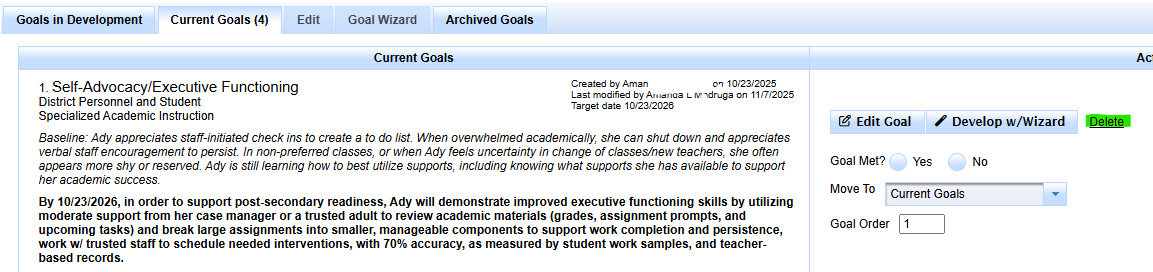
Goal actions are available from Goals Developer; permissions determine who can delete a goal.
Create a New Goal
Best practice is to create a new goal for the new IEP. Staff can create that new goal with either GoalWizard or Create New Blank Goal. Both methods create a goal for the upcoming IEP in Goals in Development.
Option 1: Create New Goal with GoalWizard
Choose Create New Goal with GoalWizard when GoalWizard can help build the goal. GoalWizard walks staff through the goal bank, standards, setting/condition, behavior, criteria, mastery, measurement, and baseline. This is the encouraged starting point when it fits the goal being written.
Option 2: Create New Blank Goal
Choose Create New Blank Goal when staff want to write the new goal from scratch. This is a primary goal-creation method, not an exception or fallback. Staff who do not want to use GoalWizard can still create a new goal directly and complete the required Goal Editor fields.
Keep/Revise can carry an existing Current Goal into Goals in Development so it can be revised, but it is secondary to creating a new goal. SELPA guidance is not to use Keep/Revise for academic goals.
For an upcoming IEP, the new goals belong in Goals in Development. When the finalized IEP takes effect, those goals become Current Goals, and the previous Current Goals and progress move to archived history.
3. Work With Existing / Current Goals
Sometimes staff need to add or modify goals that belong to the Current IEP. When an Addendum/Amendment or Other Review is opened to add or modify goals, staff work with the Goal form or the Current Goals tab in Goals Developer.
Goals Developer list view retained from the original article for reference.
_files/image055.jpg)
_files/image056.jpg)
Use the applicable Current Goals view when the meeting is changing goals in the plan already in effect.
A new Current Goal can be added from the Goal form or by using GoalWizard / Create Blank Goal from the Current Goals tab. When finished, open the Annual Goals page in IEP Manager to review the existing goals together with any newly added goal.
_files/image057.jpg)
The Current Goals area can also display goals that use benchmarks or objectives.
Deleting Current Goals
The original Article 120 states that an existing/current goal should not simply be deleted or removed because all goals agreed to in the Current IEP—including goals met early or no longer applicable—must remain accounted for through the next Annual Review.
Goal Met Early
Use Progress Report Help and indicate that the goal was Met. The goal remains part of the Current IEP history until the next Annual Review, but once it is marked met early, staff no longer need to continue reporting progress on it.
Goal Discontinued / Abandoned
Use the Progress Report, indicate Not Met, and select Discontinued/Abandoned as the reason. The goal remains accounted for through the next Annual Review, with the outcome documented in the progress history.
_files/image058.jpg)
GoalWizard can also be used when a new goal is being added through the appropriate current-plan workflow.
The same Goals Developer area supports work with Current Goals as well as Goals in Development.
Open the applicable Goal form in IEP Manager to review goal changes made through the current-plan workflow.
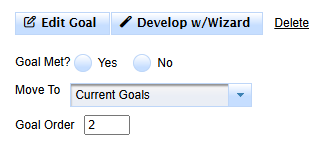
Goal actions in Goals Developer are available according to the user's permissions.
4. Goal Editor Fields
Whether staff use GoalWizard or Create New Blank Goal, Goal Editor includes fields used to finish the goal record.
Goal Status
The original guidance states that Goal Status defaults to Current Goal.
Associated Service
Optional. Associate a service to a goal when appropriate. This association is used by Service Log to list goals for the selected service.
Area of Need
Select the area from Present Levels and/or Transition that is addressed by the goal. The original guidance also allows staff to enter an area when appropriate and notes that more than one area may apply.
Responsible Discipline
Staff may list multiple disciplines responsible for implementing the goal. The original guidance states that the first discipline listed is responsible for collecting the data and completing scheduled Progress Reports for that goal.
Target Date
Use the date when progress on the goal or benchmark will be reported. The original guidance notes that the goal Target Date is usually one year after the IEP.
Reason for Goal
When this field is available for the SELPA, describe the student's current need in terms the parent can understand. Explain the behavior addressed, why the skill is important, and how the need affects the student's educational progress. If the student had a prior goal in the same area, include the relevant progress or lack of progress and why the area continues to be a need.
Goal records can be reviewed and edited from Goals Developer according to user permissions.
5. Goals Developer List & Views
Once a goal has been developed, the person who created the goal or the Special Education Clerk may be able to edit or delete the goal according to permissions. Goal Order controls the order in which goals appear in the IEP Manager goal pages.
Goals in Development
This is the default tab and is where staff develop goals for the upcoming IEP.
Goals in Development contains goals being prepared for the upcoming IEP.
Current Goals
The Current Goals tab lists goals used by the Current IEP and Progress Report.
Goals Only is used when the student's goal structure does not use benchmarks/objectives.
Benchmark view
When benchmarks are used, select Add Benchmark after developing the goal to create the benchmark/objective entries.
Use the benchmark view to add benchmark/objective entries when required.
6. Use GoalWizard
GoalWizard helps staff assemble a goal by selecting the Target Date, Setting/Condition, Behavior, Accuracy/Criteria, Consistency/Mastery, Measurement Instrument, and the student's baseline.
1. Select Setting / Condition
Begin by selecting the Area of Need and then the Setting and/or Condition.
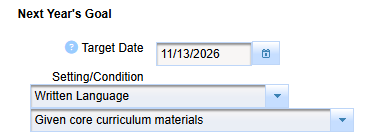
Select the Area of Need and the setting/condition for the goal.
2. Select the Behavior
Select the Domain, Category, and grade when appropriate, then choose the behavior or skill that will be part of the goal or objective.
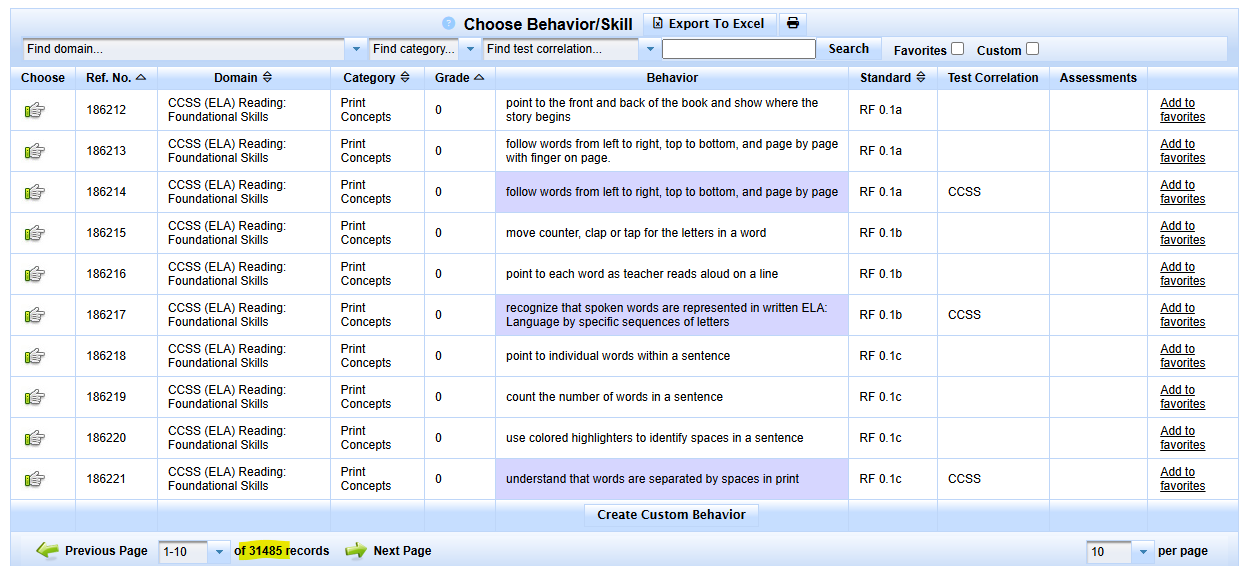
Use Domain, Category, and grade filters to locate the behavior for the goal.
3. Enter criteria, mastery, measurement, and baseline
Enter the goal's Accuracy/Criteria, Consistency/Mastery, and Measurement Instrument. Then enter the student's baseline for the selected behavior.
4. Assemble the goal
Review the developing goal and baseline, then select Assemble Goal.
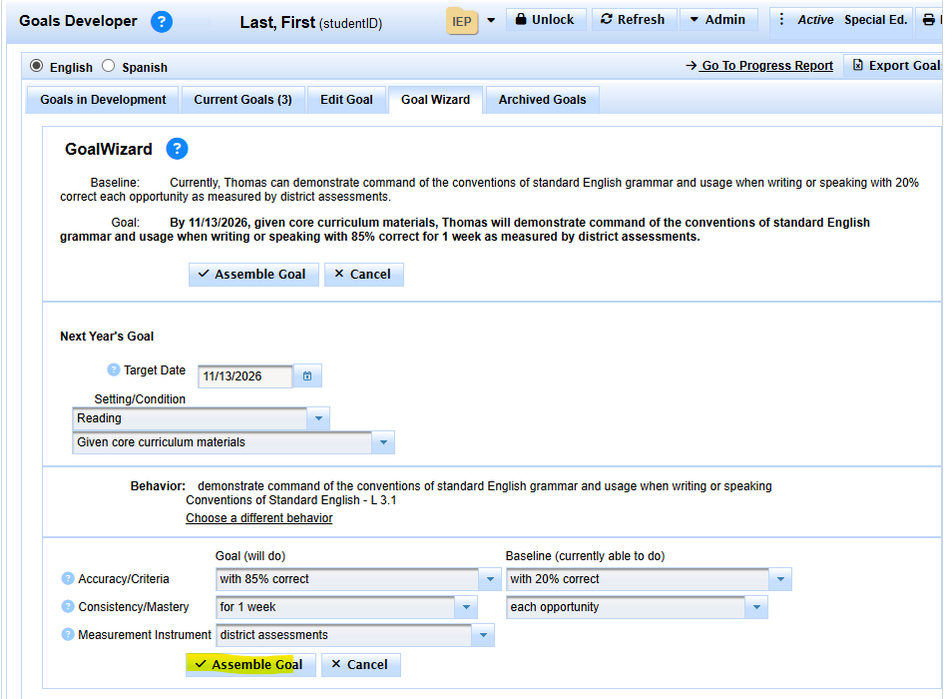
Review the criteria and baseline, then assemble the goal.
5. Review the Goal Editor
Make adjustments to the assembled goal and add Associated Services and the responsible staff information as appropriate.
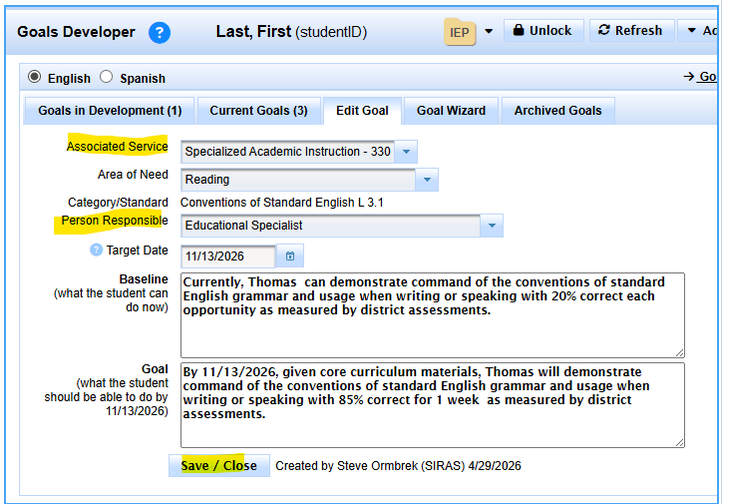
Review the assembled goal in Goal Editor before saving.
6. Save / Close and review the Goal form
Select Save/Close. When the applicable Goal or Goal and Benchmark form is opened in IEP Manager, review the goal that was entered from Goals Developer.
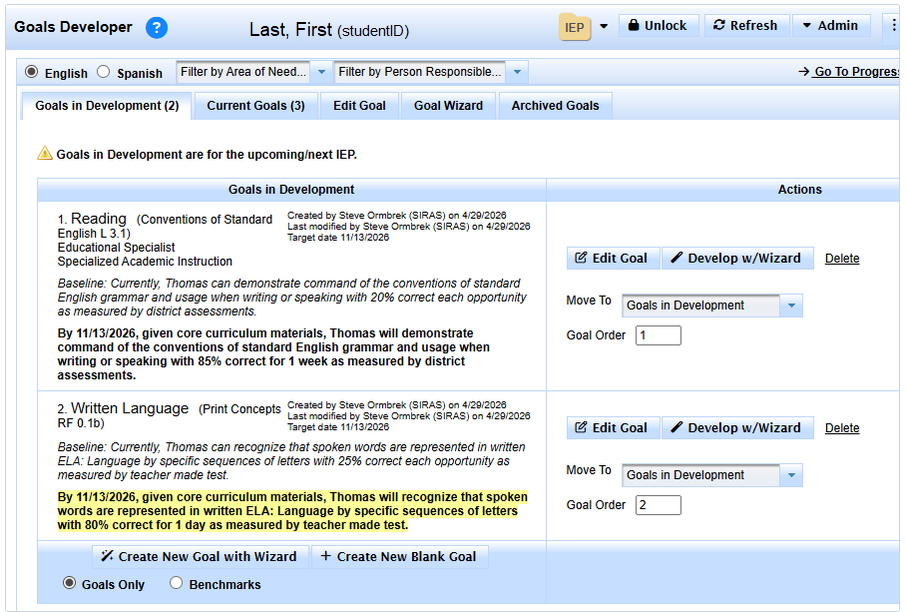
After saving the goal, open the applicable Goal form in IEP Manager and review the populated goal.
Before beginning a new progress cycle, confirm the previous year's Current Goals and Current Progress are preserved in Archived history, and confirm the newly effective goals are the student's Current Goals. Then use Progress Report Help for the new Current Goals.
7. Training Videos
The three Goals Developer training videos are available at the top of this article for quick access: Develop Benchmarks, Develop Goals, and GoalWizard / Common Core.
For the main IEP Manager workflow, see IEP Manager Help. For Progress Reports, see Progress Report Help.

