


Transition IFSP to IEP Meeting Procedure – Part C to Part B
Use this guide when a child currently receiving Part C / IFSP services is approaching age three and the IEP team must determine whether the child will be eligible for Part B / IEP services.
The Part C-to-B process begins before the IFSP ends. The IFSP provider continues its Part C responsibilities while the IEP district completes the transition referral, evaluation, and meeting work. SIRAS must preserve the IFSP district's Current record and reporting responsibility while also allowing the appropriate IEP district to document and report the Part B outcome.
For a new Part C referral, an IFSP transfer, or a Regional Center handoff that is not yet an age-three transition, see New, Transferring & Incoming IFSP Students.
When an existing SIRAS IFSP record is involved, use Next Year's District and provider assignments so the IEP district can perform the Part C-to-B work while the IFSP district retains Current ownership. Plan Adoption is used later only when a receiving district actually adopts an existing plan after the record enters its scope.
Which Part C-to-B Starting Point Applies?
| Starting point | SIRAS setup | CALPADS context |
|---|---|---|
| Existing SIRAS IFSP record A SIRAS district is currently providing IFSP services. |
The IFSP district keeps the Current record. Enter the IEP district as Next Year's District when that district will conduct/report the Part B evaluation, then assign the necessary IEP staff. | Ongoing IFSP transactions continue to report under the IFSP district. The Part C-to-B Initial Evaluation transaction is attributed to the IEP district identified for the transition work. |
| Regional Center-only IFSP The Regional Center continues Part C services and no SIRAS/CALPADS special education record exists yet. |
The SIRAS district creates the record to document the entire Part C-to-B referral and its outcome. Do not create Plan Adoption because the district is not adopting the Regional Center IFSP for ongoing district IFSP service delivery. | The completed Part B evaluation or the appropriate Part C closure/status outcome establishes the CALPADS transition result. |
1. Document the Part C Transition Planning Meeting
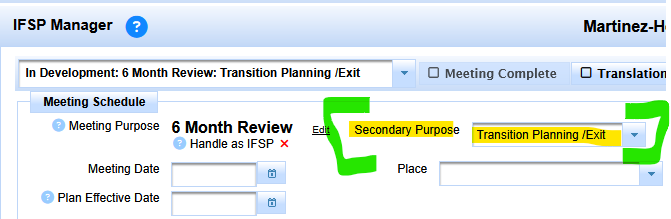
When the IFSP team holds the required transition planning/conference activity, document it in the IFSP meeting using the secondary purpose Transition Planning/Exit.
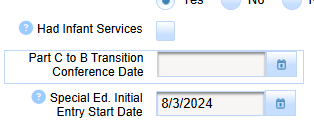
SIRAS uses that selection to populate the applicable CALPADS PLAN transition fields, including the Part C-to-B Transition Conference Date and whether the conference was timely.
For current PLAN fields, service locations, referral sources, delay reasons, and other CALPADS codes, use the current CALPADS System Documentation. For the transition conference fields, see CALPADS Update Flash 314.
2. Prepare Shared Access When a SIRAS IFSP Record Already Exists
IFSP district responsibilities
- Keep the IFSP record Current at the IFSP district while the child remains eligible for and is receiving Part C services.
- Confirm the MIS Summary accurately reflects the current IFSP plan and history.
- When another district will conduct and report the Part B Initial Evaluation, enter that district as Next Year's District.
- Assign the specific IEP staff who need access to prepare the transition evaluation and meeting.
- Continue documenting IFSP amendments, reviews, services, and other Part C work until the IFSP responsibility ends.

IEP district access
The future IEP district uses the Incoming Students view to access the shared record while Current ownership remains with the IFSP district.


The IFSP district may continue owning the Current record while the transition Initial Evaluation archive is created under the future IEP district. This lets both teams document their actual responsibilities without transferring the child prematurely.
When the evaluating district is not the future service district
If the IFSP district will conduct/report the Part B Initial Evaluation on behalf of a different district that will later provide IEP services, do not enter the future service district as Next Year's District until after the Initial Evaluation is completed. Otherwise, the transition transaction may be attributed to the wrong district.
After the evaluation and plan are completed, the future service district can receive the record and use Plan Adoption Guide when adoption of the completed incoming IEP is appropriate.
3. Create the Record for a Regional Center-Only Part C-to-B Transition
When the child receives IFSP services only through a Regional Center, the SIRAS district creates a record to document the entire Part C-to-B referral process, not merely a future Part B meeting.
- Create the student/referral record using the best available Regional Center and family information.
- Identify that the child had infant services.
- Enter the referral, assessment, and transition information needed for the IEP team to document what happens in the field.
- Do not create Plan Adoption; the Regional Center IFSP expires at age three and is not being adopted by the IEP district.
- Complete the transition workflow and let the actual outcome determine the SWDS, MEET, PLAN, and SERV reporting.

If the Part B Initial Evaluation does not occur, the SIRAS district working with the Regional Center may still need to report the appropriate Part C closure/status outcome so the IFSP story is closed in CALPADS.
4. Create the Part C-to-B Initial Evaluation Meeting
- Confirm Had Infant Services is selected on the MIS Summary.
- Do not change the student's existing Special Education Initial Entry Start Date merely because the Part B Initial Evaluation is being created.
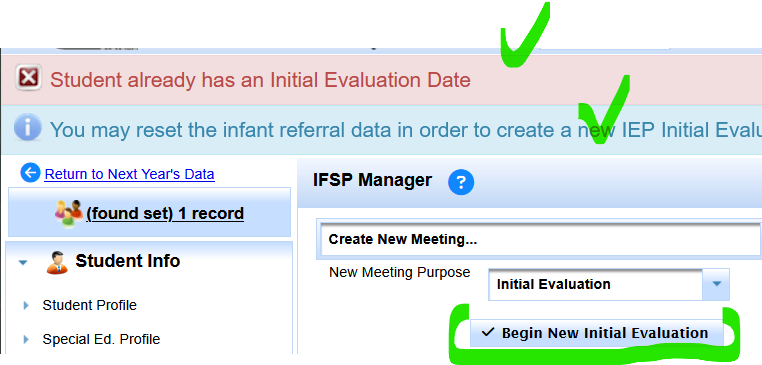
- In IEP Manager, create an Initial Evaluation meeting.
- If SIRAS warns that the student already has an Initial Evaluation Date, confirm the transition setup and proceed. The earlier Part C Initial Evaluation remains part of the history.
- It is acceptable for SIRAS to clear/rebuild referral fields needed for the Part B process; do not overwrite the historical Special Education Initial Entry Start Date.
- Confirm the Plan Effective Date reflects when the Part B plan/services will actually begin—commonly the third birthday, but the date must align with the real enrollment and service-start circumstances.


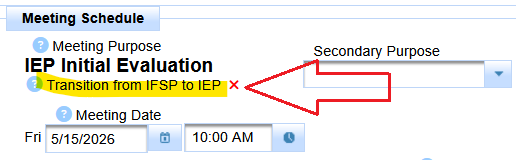

If an IFSP amendment or review is already open, create a separate Part C-to-B Initial Evaluation meeting. The two teams may have legitimate work occurring at the same time.

If the meeting was created with the wrong plan/meeting context, use the available meeting-purpose controls to correct the Part C-to-B setup before staff begin completing forms.

5. Report the Actual Part C-to-B Outcome
The field outcome determines what SIRAS should report. Do not report a separate IFSP exit when a completed Part B Initial Evaluation already provides the transition outcome.
| Outcome in the field | Reporting direction |
|---|---|
| Part B evaluation occurs; child is eligible and the IEP is accepted | Report the Part B Initial Evaluation MEET and the resulting IEP PLAN/SERV. If the child was already reported as SWDS 1 through an LEA IFSP, no new SWDS status is needed merely to continue eligibility. If the child was Regional Center-only, report the appropriate new SWDS status with the Part B result. |
| Part B evaluation occurs; child is not eligible | Report the Part B Initial Evaluation MEET with the ineligible outcome and the appropriate SWDS 4 closure. No IEP PLAN/SERV is reported. |
| IFSP/IEP team determines no Part B evaluation is necessary | Report the appropriate SWDS 4 Part C closure/status outcome as of the child's third birthday. No Part B MEET/PLAN/SERV is reported. |
| Parent does not consent to the Part C-to-B Initial Evaluation | Report the appropriate SWDS 4 refusal/closure outcome as of the child's third birthday. No Part B MEET/PLAN/SERV is reported. |
| Evaluation occurs and eligibility is established, but participation/plan acceptance does not begin immediately | Report the Part B Initial Evaluation and the SWDS status that accurately reflects the child's current participation/plan outcome. Layer later SWDS/PLAN/SERV records when the field circumstances change. |

For the current statewide combinations and dates, see the CDE Special Education File Submission Scenarios, especially the Part C-to-B transition scenarios.
6. Finalize the Transition & Transfer Current Responsibility
Finalizing the Part C-to-B meeting creates an archived transaction based on the district responsible for the transition evaluation. It does not necessarily mean the Current IFSP record should immediately move away from the IFSP district.
Keep Current at the IFSP district while Part C work continues
The IFSP district may need the Current record through the child's third birthday to complete services, amendments, a six-month review, transition documentation, or other final Part C work. In that case, preserve Next Year's Data and do not apply the future district assignment early.
Transfer after the child turns three and IFSP work is complete
When the child has turned three and the IFSP district is finished with the Current record, the IFSP district manually uses Advance and Apply Next Year's Data. This applies the future district, school, and provider assignments and transfers Current responsibility to the IEP district.
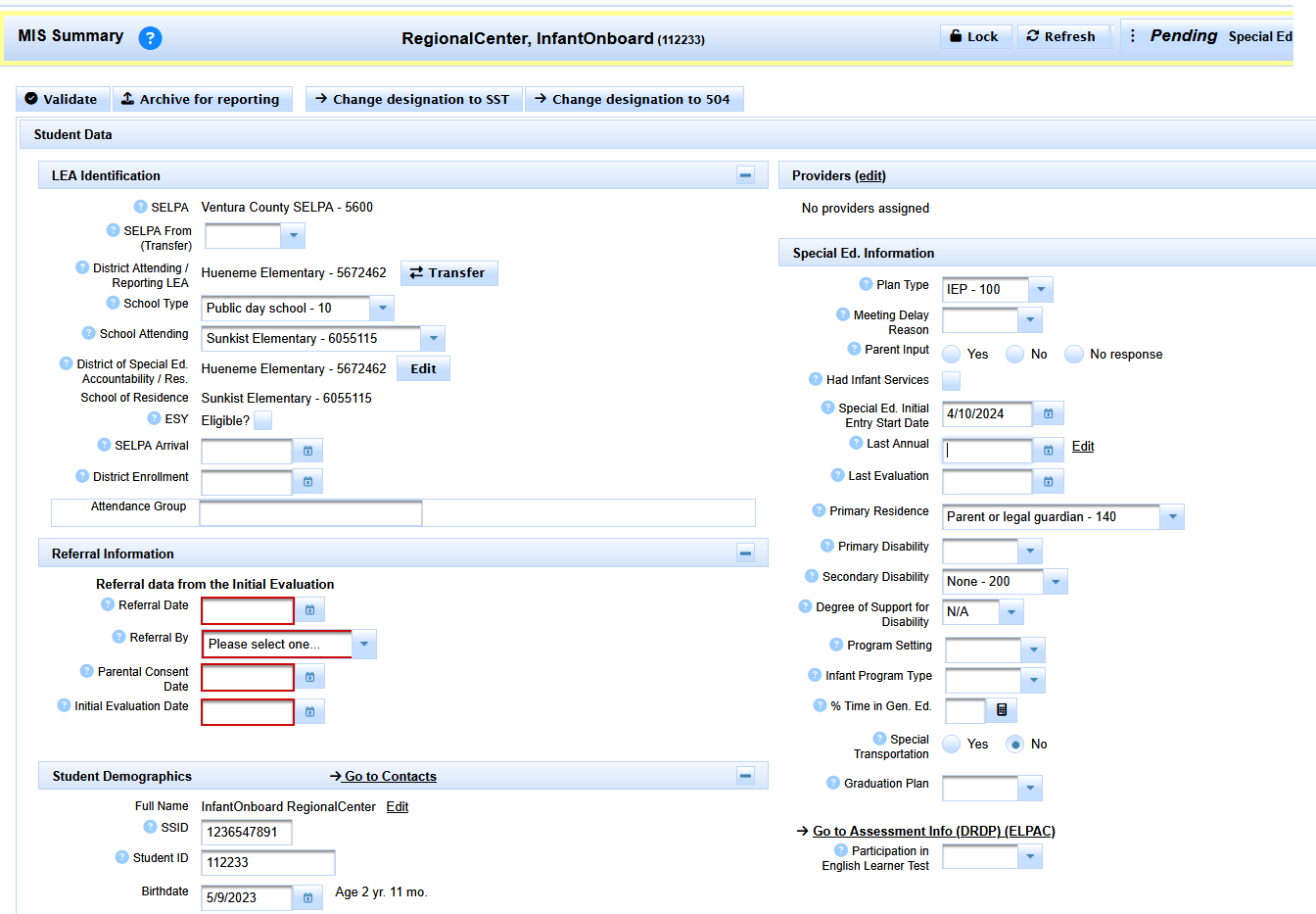
The intended future district is already represented in Next Year's Data. The IFSP district should apply that future assignment when the age-three transition and remaining IFSP work are complete.
See Next Year's Data for the conceptual explanation of shared access and future district assignment.
7. Part C-to-B Transition Checklist
- ☐ Identify whether the starting record is a SIRAS IFSP or a Regional Center-only IFSP.
- ☐ Document the transition planning/conference activity using the correct secondary purpose.
- ☐ Confirm which district will conduct and report the Part B Initial Evaluation.
- ☐ Preserve Current ownership at the IFSP district while Part C work continues.
- ☐ Use Next Year's District and provider assignments to give the appropriate IEP team access.
- ☐ Confirm Had Infant Services and preserve the historical Special Education Initial Entry Start Date.
- ☐ Create a separate Initial Evaluation meeting without disrupting open IFSP work.
- ☐ Report the actual field outcome—eligible, ineligible, no evaluation needed, refusal, or delayed participation.
- ☐ Do not report a separate IFSP exit when the completed Part B evaluation already provides closure.
- ☐ After age three and completion of IFSP work, have the IFSP district apply Next Year's Data to transfer Current responsibility.

