


SIRAS is a web-based student information and meeting-management platform supporting Special Education, Section 504, and SST workflows.
SIRAS combines student records, forms, meetings, reporting tools, goals, service documentation, integrations, and role-based access while allowing each program area to follow the data rules that apply to that designation.
| New to SIRAS?
Start with the SIRAS User Manual and its Getting Started section. |
Who Uses SIRAS?See the public list of participating SELPAs, districts, county offices, and state special schools. |
| What can SIRAS do?Forms, reporting, SIS integration, DRDP, assessment support, Service Logs, and more. | Technology & EvolutionHow SIRAS evolved from early web-based Special Education software into the current platform. |
Partnerships, Privacy, and the SIRAS Community
 SIRAS Systems supports the California SELPA Association as a Champions Club partner.
The Association's current partner listing identifies SIRAS Systems at the Influencer Level. This partnership reflects SIRAS Systems' ongoing connection with California SELPAs and the administrators who coordinate Special Education programs across the state.
Your district can sign a CA‑NDPA with us effortlessly through CITE’s SDPC platform — either by joining our existing agreement or creating your own. CITE’s statewide privacy framework keeps the process fast, compliant, and easy.
SIRAS was also invited to the White House as part of its commitment to the Joining Forces initiative supporting military-connected children with disabilities.
Visit Who Uses SIRAS? for the current public list maintained in the SIRAS knowledge base.
What SIRAS Supports
| Program area | Examples of SIRAS support |
|---|---|
| Special Education | IEP/IFSP workflows, Current/MIS data, goals, services, SEDS/CALPADS reporting, assessment support, monitoring, and historical reporting transactions. |
| Section 504 | 504 referral, eligibility/review, plan forms, current 504 information, accommodations, follow-up, and SIS handoff. |
| SST | SST referrals, meetings, interventions, General Education information collection, follow-up decisions, and transfer to 504 or Special Education when appropriate. |
Special Education, 504, and SST can use similar screen names—such as Summary Page or Forms Manager—but the underlying data flow and reporting responsibilities can differ by designation.
Common SIRAS Capabilities
- visually accurate, data-mapped, and customizable forms;
- meeting scheduling, follow-up, and designation-specific meeting workflows;
- IEP goal development and progress reporting;
- secure form-link distribution and electronic-signature workflows;
- Service Log documentation for delivered IEP and related services;
- customizable search, student-list, statistical-report, meeting-report, and full data-export tools;
- Special Education CALPADS API reporting and validation support;
- TOMS API and export support for statewide assessment accommodations/designated supports;
- SELPA-based DRDP reporting support, including SIRAS tools for collecting, monitoring, validating, and supporting SELPA reporting of DRDP ratings;
- the ability to have bidirectional integration with any SIS system through available APIs and/or secure file-based exchange, depending on the receiving SIS interface;
- Aeries integration, including API-based SIS → SIRAS demographic/contact exchange and SIRAS → Aeries Special Education data files;
- file-based integration options for other SIS platforms, allowing information to move both into and out of SIRAS;
- role-based access for providers, administrators, SEDS staff, and other authorized users; and
- contextual page and field help throughout the application.
For integration architecture, see SIS Integration: Start Here. For SELPA DRDP reporting procedures, see DRDP for SELPA.
Meeting-Driven, Data-Aware Workflows
Forms Manager and meeting workflows are central to SIRAS. Data entered during a meeting interacts with the student's Current record according to the workflow and designation that own that data.
| Designation | Data-aware workflow |
|---|---|
| Special Education | IEP meeting data, Parent Response, Pending Changes when necessary, Current/MIS, archived SEDS transactions, and CALPADS reporting form a connected—but distinct—data lifecycle. |
| Section 504 | The 504 Forms workflow returns applicable completed 504 information to the 504 Summary Page through its own Meeting Held/finalization process and then supports implementation, review, and SIS handoff. |
| SST | The SST workflow returns completed information to the SST Summary Page and uses the SST Decision to determine continued intervention, follow-up, completion, or referral to another designation. |
A meeting document, Current student data, a historical reporting transaction, an SIS record, and a state-reporting record may describe related facts without being the same record. SIRAS workflows are designed around those distinctions.
The SIRAS Core Concept — Internal Data Flow
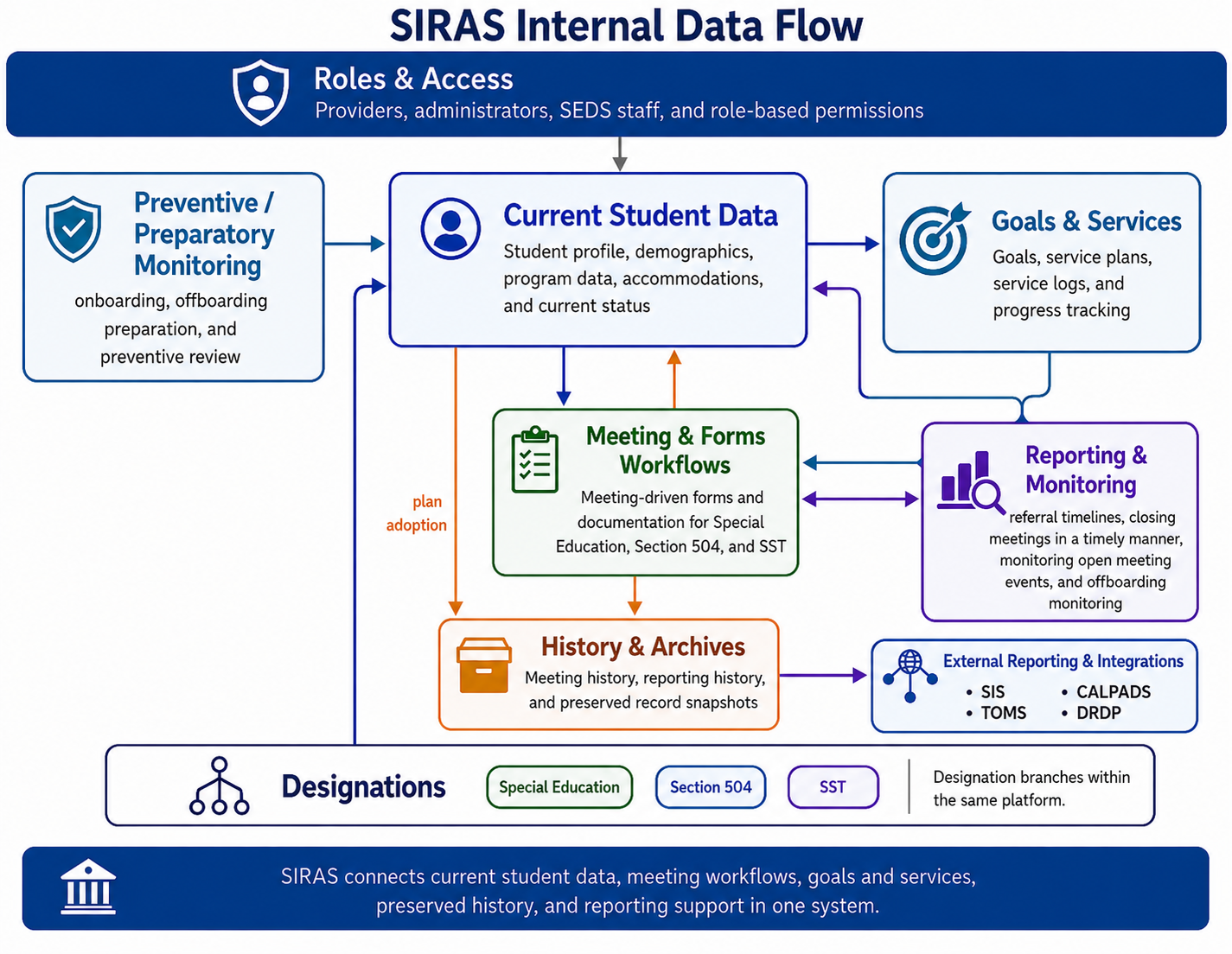
How to read the diagram:
- Roles & Access governs the environment. Providers, administrators, SEDS staff, and other authorized users interact with SIRAS according to role-based permissions.
- Preventive / Preparatory Monitoring comes first. Onboarding, offboarding preparation, and preventive review help make the Current record accurate before downstream work begins.
- Current Student Data is the operational center. Student profile, demographics, program data, accommodations, and current status supply the context used by other SIRAS workflows.
- Goals & Services feed Meeting & Forms Workflows. Goals, service plans, Service Logs, and progress information connect to the meeting/documentation process instead of bypassing it directly into reporting.
- Meeting & Forms Workflows preserve history. Completed meeting activity can create or update the history appropriate to the designation and workflow.
- Plan Adoption can move verified Current data directly into History & Archives. This represents a documented event where Current/MIS is updated and the corresponding reporting transaction is archived without requiring a new IEP meeting event.
- Reporting & Monitoring is an operational follow-up layer. It includes referral timelines, closing meetings promptly, monitoring open meeting events, and offboarding monitoring.
- History & Archives supports external reporting and integrations. The diagram groups SIS, CALPADS, TOMS, and DRDP as external destinations connected to the broader SIRAS data model. The exact direction, file/API method, and reporting responsibility depend on the destination and designation.
Use designation-specific articles for operational instructions. Special Education, Section 504, and SST share the SIRAS platform, but their meeting, status, history, and reporting rules are not identical.
Technology and the Evolution of SIRAS
The application that became SIRAS grew out of early web-enabled Special Education software. Over time, that foundation evolved into the current SIRAS platform as California reporting requirements, browser technology, electronic forms, integrations, and district data needs changed.
From web-enabled forms to a connected student-data platform
The earlier SIRAS architecture established a web-based approach to student data and Special Education forms at a time when many education systems were still desktop- or file-centered. The platform evolved beyond form creation into a system that connects Current student data, meeting workflows, historical records, state reporting, assessment support, service documentation, and external systems.
Structured data underneath visually accurate forms
SIRAS uses structured relational data so the same verified student information can support forms, searches, reports, integrations, and downstream workflows. Its form technology was designed to preserve familiar, visually accurate education forms while mapping fields back to reusable student data rather than treating every document as an isolated file.
Modern web interaction and secure collaboration
The platform evolved toward dynamically updating browser interfaces, contextual help, secure form links, electronic signatures, and remote collaboration. These capabilities allow parents, general education staff, providers, administrators, and other authorized participants to interact with the appropriate parts of a student's workflow without turning the student record into a collection of disconnected documents.
Interoperability became a core capability
SIRAS has continued to expand its connections with external systems. Current examples include CALPADS API reporting, TOMS-related API/export workflows, SELPA DRDP reporting support, Aeries integration, and secure file-based integration patterns that can support bidirectional exchange with other SIS platforms.
Help, Training, and Support
Contextual help is available throughout SIRAS, including page-level help and field-level question-mark help where provided.
- SIRAS User Manual — general entry point and Getting Started resources.
- Support Guide for Providers — provider-focused help.
- Support Guide for Administrators — administrator/SEDS-focused help.
- Email: [email protected]
- Phone: 1 (844) 33-SIRAS

