


Transition IFSP to IEP Meeting Procedure – Part C to Part B
Use this guide when a child receiving Part C / IFSP services is approaching age three and a SIRAS district must complete the Part C-to-B Initial Evaluation process.
For new Part C referrals, district IFSP transfers, Regional Center/SIRAS dual-service arrangements, and other IFSP onboarding situations, begin with New, Transferring & Incoming IFSP Students.
The Part C-to-B Initial Evaluation develops a new IEP. It does not adopt the expiring IFSP. A child may already have a prior special IFSP Plan Adoption because a SIRAS district began dually serving the child with a Regional Center, but that earlier onboarding transaction is separate from the age-three transition.
Those two facts determine whether staff use the existing record as-is, add Next Year's District access, or create a new SIRAS record for the transition.
1. Choose the Correct Record & District Scenario
| Scenario | Record setup | Transition action |
|---|---|---|
| 3A. SIRAS record exists; the IFSP district also completes the Part C-to-B Initial Evaluation | Use the existing Current record. This includes a record created earlier through the special Regional Center/SIRAS dual-service Plan Adoption described in New, Transferring & Incoming IFSP Students. | No Next Year's District is needed. The same district already has access, appears on the Initial IEP documents, and receives CALPADS attribution for the archived transaction. |
| 3B. SIRAS record exists; a different district completes the Part C-to-B Initial Evaluation | The IFSP district keeps the Current record and enters the evaluating IEP district as the Next Year's District. | SIRAS uses that district for access, the district name on the Initial IEP documents, and attribution of the archived transition transaction. |
| 3C. No SIRAS record exists; the child has a Regional Center-only IFSP | The SIRAS district responsible for the transition creates a new record to document the complete Part C-to-B referral and outcome. | Do not use Plan Adoption. The district is not beginning ongoing IFSP dual service; it is documenting and completing the age-three transition process. |
That district is establishing the new Part B plan through the Initial Evaluation. There is no completed incoming IEP to adopt.
2. Document the Part C Transition Planning Activity
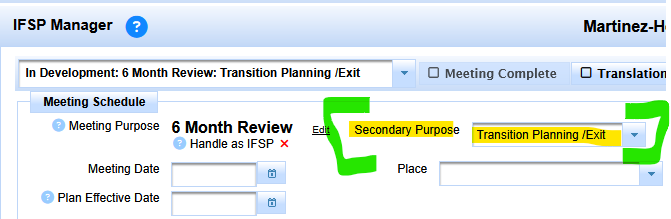
When the IFSP team holds the transition planning/conference activity, document it in the IFSP meeting using the secondary purpose Transition Planning/Exit.
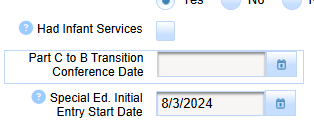
SIRAS uses that selection to populate the applicable CALPADS PLAN transition fields, including the Part C-to-B Transition Conference Date and whether the conference was timely.
3. Prepare the Record for the Applicable Scenario
3A. Existing SIRAS record; same district completes the Initial Evaluation
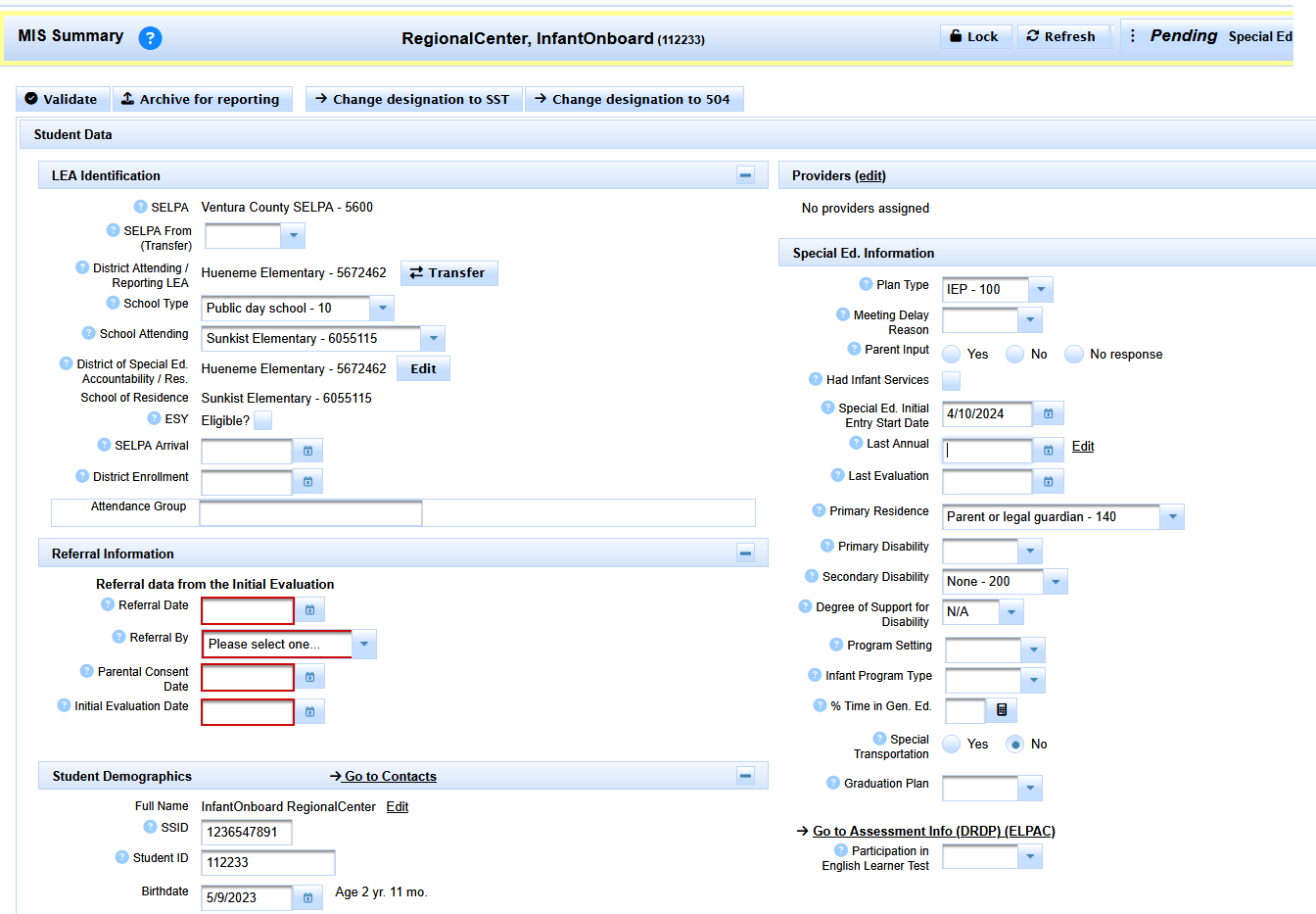
No Next Year's District is needed. Confirm that the MIS Summary, IFSP history, district information, provider assignments, and transition information are current before creating the Initial Evaluation.
The existing record may represent district-only IFSP services or a Regional Center/SIRAS dual-service arrangement previously established through the special IFSP Plan Adoption described in Article 278.
3B. Existing SIRAS record; different district completes the Initial Evaluation
The IFSP district must:
- keep the IFSP record Current while Part C work remains active;
- enter the evaluating IEP district as the Next Year's District;
- assign the specific IEP staff who need access; and
- verify the future district information before the Initial Evaluation is created.

The IEP district accesses the shared record through the Incoming Students view.


The IFSP district may retain the Current record while the Initial IEP documents display the evaluating IEP district and the archived transition transaction is attributed to that IEP district.
3C. No SIRAS record; Regional Center-only IFSP
The SIRAS district responsible for the Part C-to-B transition creates a record to document the complete referral and outcome.
- Create the student/referral record using the best available Regional Center and family information.
- Identify that the child had infant services.
- Enter the referral, assessment, transition, and notification information needed to document what occurred.
- Create the Part C-to-B Initial Evaluation when parental consent is received and the evaluation will proceed.
- If the evaluation will not proceed, document the notification and supporting process, complete all open meetings, and report the applicable inactive/non-participation reason described in Section 6.

When a district begins ongoing IFSP services alongside a Regional Center, it uses the special IFSP Plan Adoption described in Article 278. When the district is only completing the age-three transition, it creates the record and Initial Evaluation without Plan Adoption.
4. Create & Manage the Part C-to-B Initial Evaluation
- Confirm Had Infant Services is selected on the MIS Summary.
- Preserve the student's historical Special Education Initial Entry Start Date.
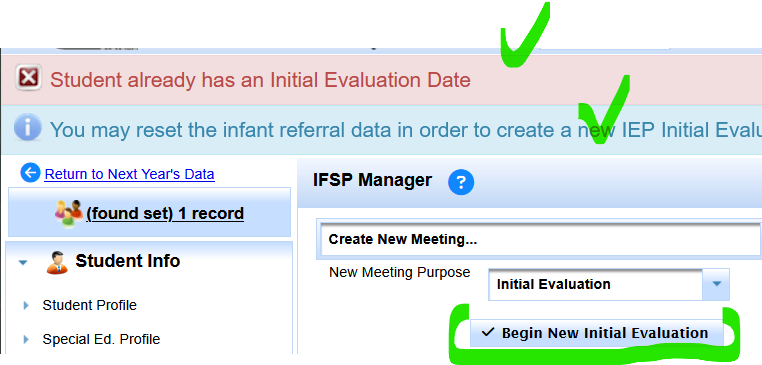
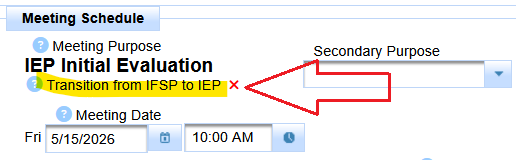
- In IEP Manager, create an Initial Evaluation meeting for the Part C-to-B process.
- If SIRAS warns that the student already has an Initial Evaluation Date, confirm the transition setup and continue. The earlier Part C Initial Evaluation remains part of the child's history.
- Review the district, provider, referral, and transition information before staff begin completing forms.


IFSP and IEP meetings may be open at the same time
An IFSP meeting—including a primary IFSP meeting—may remain open alongside the Part C-to-B Initial Evaluation. This is not ideal, but it is not uncommon when both teams have legitimate work occurring at the same time.

When IFSP and IEP meetings are open concurrently, IFSP and IEP team members must verify the complete meeting-document preview before finalizing. Confirm that the correct district, plan type, forms, dates, and data appear in each document.
If the meeting was created with the wrong context, correct the meeting type or purpose before staff complete the forms.

5. Plan Effective Date & Service Start Date
Plan Effective Date
- The Plan Effective Date can be no earlier than the child's third birthday, even when the parent signs before the third birthday.
- SIRAS should set the third birthday as the default.
- If the parent approves the plan after the third birthday, adjust the Plan Effective Date to the later parent-signature/approval date.

Service Start Date
- The SIRAS Service Start Date can be no earlier than the child's third birthday.
- It does not have to be changed to match the Plan Effective Date unless local district or SELPA policy requires that alignment.
- The SIRAS Service Start Date identifies when the IEP team considers the service ready to begin or effective in the field. Actual service delivery still depends on parental approval of the plan.
The SIRAS Service Start Date is an IEP service field used for local implementation and service-log purposes. The effective date reported in the CALPADS SERV file is derived from the Plan Effective Date. See Plan Effective Date, Service Start Date & CALPADS SERV Reporting for the full distinction.
6. Report the Actual Part C-to-B Outcome
The completed process may result in eligibility with participation, eligibility without a current plan, ineligibility, or no Part B evaluation. Report the outcome that actually occurred.
| Field outcome | SIRAS / reporting direction |
|---|---|
| Eligible and participating | Finalize the Part B Initial Evaluation and report the IEP PLAN and SERV records. If archived SIRAS transactions show that the child already has SWDS [1] Eligible and Participating for existing IFSP services from another SIRAS district, SIRAS does not automatically report another SWDS [1]. This avoids the CALPADS SWDS0618 IVR error. If no district-reported SWDS baseline exists, the transition transaction establishes the applicable SWDS status. |
| Eligible, but parent declines the offered FAPE/education plan | Use NONPART [11] Eligible - No Education Plan (Parent Declined FAPE). |
| Eligible, but no current plan because a future plan/start is expected | Use NONPART [12] Eligible - No Education Plan Currently (Future Plan Expected). |
| Initial Evaluation completed; child did not qualify | Use NONPART [21] Not Eligible based on Initial Evaluation (DNQ). No IEP PLAN or SERV records are created. |
| Parent does not consent to the Part C-to-B Initial Evaluation | The district that the parent notified reports NONPART [22] No Parental Consent Received - Part C to B. That district must document receipt of the notification and all appropriate supporting documentation. Report the inactive transaction only after all open meeting events have been completed or appropriately closed. |
| The IFSP team determines that no Part B evaluation is needed | The IFSP team reports NONPART [26] IFSP Team Determined No Part B Evaluation Needed. The IFSP team must document the determination, notification process, and supporting documentation. Report the inactive transaction only after all open meeting events have been completed or appropriately closed. |
| Evaluation finds the child eligible, but the parent does not accept eligibility | Report the student as not eligible using NONPART [27] Not Eligible - No Consent for Eligibility. |

After all open meetings are completed and the final no-evaluation outcome is documented, use When Students Leave, Stop Participating, or Become Inactive for the Current inactive status, effective date, archive, and CALPADS follow-up.
7. Complete IFSP Documentation & Transfer Current Responsibility
No separate IFSP exit is reported to CALPADS
The Part C-to-B result provides the required reporting outcome. The IFSP team does not need to report a separate IFSP exit transaction to CALPADS.
The IFSP team may still create an IFSP meeting event to document exit progress, final outcomes, family communication, or other local documentation. That optional meeting is for documentation and does not create a separate CALPADS IFSP exit requirement.
Same IFSP and IEP district
No district transfer or Next Year's District application is needed. Complete the IFSP and IEP meeting work, verify all documents, and retain the Current record with the district.
Different IFSP and IEP districts
The IFSP district retains Current responsibility while Part C work remains open. After the child reaches age three, all IFSP work is complete, and the open meeting documents have been verified and finalized, the IFSP district uses Advance and Apply Next Year's Data.
This applies the future district, school, and provider information and transfers Current responsibility to the IEP district.
The evaluating IEP district is already identified through Next Year's Data, and the new IEP was developed through the Part C-to-B Initial Evaluation.
See Next Year's Data for the shared-access and future-district model.
8. Part C-to-B Transition Checklist
- ☐ Use New, Transferring & Incoming IFSP Students for IFSP arrival, transfer, or dual-service questions.
- ☐ Determine whether the SIRAS record already exists.
- ☐ Confirm which district is completing and reporting the Part C-to-B Initial Evaluation.
- ☐ If the IFSP and IEP district are the same, do not add unnecessary Next Year's Data.
- ☐ If a different IEP district is evaluating, enter it as Next Year's District before creating the Initial Evaluation.
- ☐ If no SIRAS record exists, create the record for the complete Part C-to-B referral and outcome.
- ☐ Document the transition planning/conference activity using Transition Planning/Exit.
- ☐ Confirm Had Infant Services and preserve the Special Education Initial Entry Start Date.
- ☐ When meetings overlap, have both teams preview their complete documents before closing either meeting.
- ☐ Keep the Plan Effective Date no earlier than the third birthday and adjust it to a later parental approval date when applicable.
- ☐ Keep the Service Effective Date no earlier than the third birthday; align it with the Plan Effective Date only when local policy requires.
- ☐ Do not report a duplicate SWDS [1] Eligible and Participating when SIRAS already has the IFSP SWDS history.
- ☐ Report the actual result using the exact applicable NONPART code and label.
- ☐ For NONPART [22], the district notified by the parent documents and reports the outcome.
- ☐ For NONPART [26], the IFSP team documents and reports the determination.
- ☐ Complete or appropriately close all open meetings before reporting a no-evaluation inactive reason.
- ☐ Do not report a separate CALPADS IFSP exit.
- ☐ Do not use Plan Adoption or Request Transfer for the planned Part C-to-B transition.
- ☐ When districts differ, apply Next Year's Data only after age three and completion of IFSP work.
- ☐ After a final inactive outcome, follow When Students Leave, Stop Participating, or Become Inactive for status and reporting completion.

