


Use Quick Search to find one student. Open Search when you need a group of students that meet selected criteria.
When a query is active, the Search control changes to Modify / Reset Search. Select Reset Search to clear the query and restore the records normally available within your current View Scope and permissions.
| Find One StudentUse Quick Search and understand the current Found Set. | Build a QueryChoose or type criteria in Query Builder. |
| Type to Narrow Add CriteriaUse the look-ahead field menu instead of scrolling through every field. | Other Search MethodsPredefined, Saved, Historical-Advanced, and ID List. |
| View ScopeUnderstand how scope and an active query work together. | Verify the ResultCheck the Found Set before reports, exports, or batch actions. |
| Marked RecordsHand-pick students or mark a visible group, then use Find only marked students to make those records the active Found Set. |
Quick Search and the Current Found Set
The Choose Student link is below the SIRAS logo. The number displayed with it shows how many records are currently in the Found Set.

Choose Student displays the size of the current Found Set.
Use the Quick Search text box when you need one student. Search with identifying information such as a partial name, local student ID, SSID, or birthdate.

Use Quick Search for an individual student instead of building a multi-field query.
For the relationship between a student, Found Set, and View Scope, see Navigation in SIRAS and Found Sets: How SIRAS Selects Records.
Build a Basic Search Query
- Select Search at the top of SIRAS.
- The Search/Query dialog opens.
- In the upper Query Builder, select or type into Add Criteria.
- Select the field you want to search.
- Set the applicable value, condition, date, range, or other option.
- Add another criterion only when it is needed.
- Select Search to List or the applicable search action.
- Verify the resulting Found Set before continuing.

Query Builder is the normal place to create a manual search with one or more criteria.

Use Modify to adjust a query you understand; use Reset Search to clear it and return to the normal records available in the current View Scope.

Use Search to List when the criteria are ready and you want the results displayed as a student list.
Type to Narrow the Add Criteria Menu
Add Criteria is a look-ahead menu. You do not have to scroll through every searchable SIRAS field. Begin typing part of the field name and SIRAS narrows the available choices.

Typing grade narrows Add Criteria to fields with related names.
Type service into Add Criteria. SIRAS narrows the long field menu to service-related choices. Select the precise field needed for the query rather than assuming every field containing the word “service” represents the same kind of data.
This same interaction pattern appears in many other long SIRAS control menus, including field selectors used by Student Lists, Data Export, and Statistical Reports. Some long scope/organization selectors also provide a text filter. See Navigation in SIRAS — Type to Narrow Long Menus.
Typing into Add Criteria first narrows the list of fields you can choose. The student Found Set does not change until you select a criterion, provide its condition/value, and run the query.
Combine Criteria Carefully
Query Builder supports AND, OR, Include/Exclude, comparison operators, dates, and ranges. Most routine searches need only a small number of criteria.

Use AND, OR, Include, and Exclude only when they match the population you intend to find.

Some criteria support comparisons such as Between, greater than, or less than.

Check date and range boundaries before relying on the resulting Found Set.
When a predefined or internal workflow creates a result set automatically, Modify may not display a useful repeatable Query Builder definition. Use Modify for query logic you understand; use the documented workflow for automatic queries.
Predefined, Saved, Historical-Advanced, Marked Records, and ID List Searches
| Search method | How it works |
|---|---|
| Predefined Queries | SIRAS builds the query for a documented monitoring or operational purpose. |
| Saved Queries | Loads a complete query that was previously saved and verified. |
| Historical-Advanced Query | Works with Query Builder to search or compare Current and archived record data. Use documented patterns and verify the record type and date range. |
| Marked Records | Hand-pick students or mark a visible group, then use Find only marked students to make those records the active Found Set. See Finding Students by Marked Records. |
| ID List | Builds a Found Set from a pasted list of student identifiers such as SSIDs. |
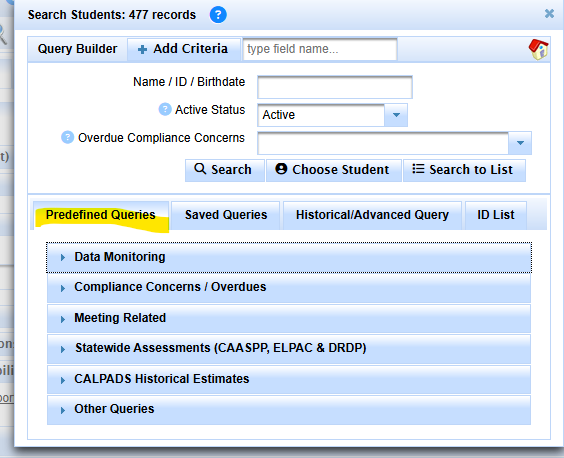
Predefined Queries provide SIRAS-built queries for named purposes.
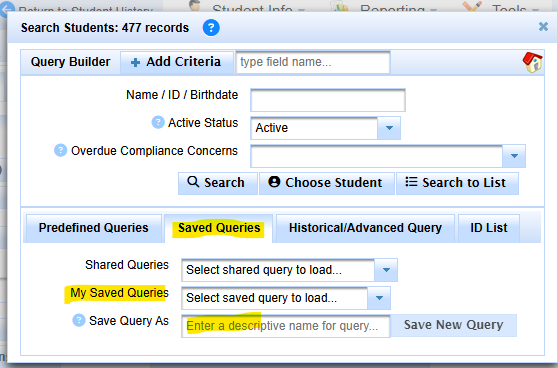
Saved Query tools let a verified query be reused rather than rebuilt.
View Scope Works with the Active Query
The schoolhouse icon is the View Scope control. It limits which district, school, school group, or individually assigned population is currently available.
An active query remains in effect when View Scope changes. For example, if you search for Grade = 6 at district scope and then change to one school, the Grade = 6 query remains active but the Found Set is now limited to that school.
Check both the active query and the current View Scope.
Marked Records — Build a Custom Found Set
Marked Records are one of the main ways to select a group of students in SIRAS. Use them when you want to choose students individually or from a visible list, then make those marked students the active Found Set.
Display or find the students → mark the intended records → choose Find only marked students → verify the Found Set count → continue with the next workflow.
Common uses include:
- building a custom Found Set in Choose Student;
- selecting students for a Service Log Group;
- creating a stable group before Batch Edit, especially when the field being changed was also used to find the students.
See Finding Students by Marked Records for the full marked-record controls and workflow.
After marking the intended students, use Find only marked students, verify the Found Set count, then continue to Batch Edit Help. See Finding Students by Marked Records for the full selection workflow.
Choose Student also provides a manual way to narrow a population. Mark the records you want, then use the marked-record controls such as Find only marked students, Omit marked, or Save marked as query.
If the Choose Student page is showing only part of the Found Set, Mark all visible does not necessarily mark every record in the Found Set.
ID List
Use ID List when you already have a group of SSIDs or Student IDs and want those students in a Found Set.

ID List prepares a search from a pasted group of student identifiers.
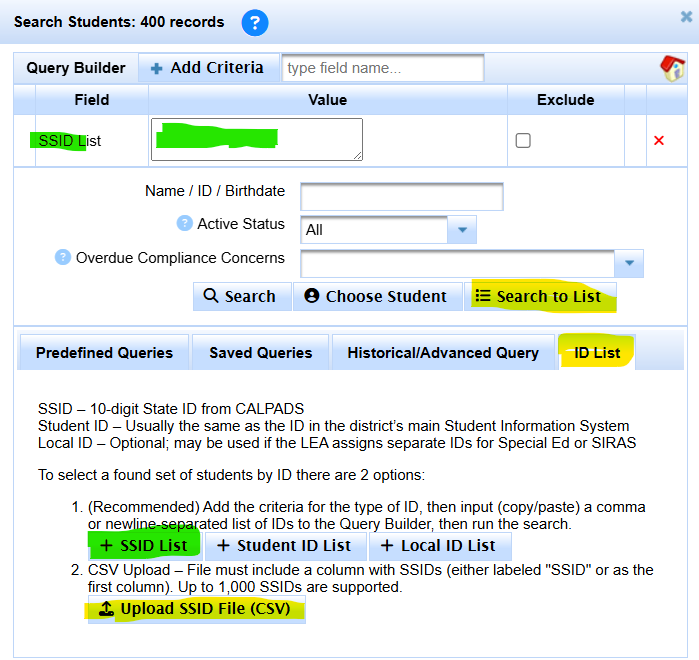
Choose the identifier type, paste the IDs, run Search to List, and verify the resulting Found Set.
Verify the Result
Before using a Found Set for a student list, statistical report, data export, progress review, or batch action:
- check the Found Set count;
- check View Scope;
- review representative records;
- confirm the criteria describe the intended population; and
- use Reset Search when you need to return to your normal population.

