


It gives you a quick view of messages, upcoming or overdue student work, meetings, and—when your access allows it—student, caseload, and user transfer requests. What you see is limited by your SELPA, district, school, caseload, View Scope, and permissions.
You can return to Home at any time by selecting the SIRAS Systems logo in the upper-left corner.

Select the SIRAS Systems logo to return to Home.
A useful routine is to check what changed since your last login, confirm your caseload, look ahead at upcoming work, notice meetings already in progress, and then open the student you need. For the full provider work cycle—record readiness, meeting preparation, parent response, closure, and progress—see Getting Started for Providers.
Start Here
| Check Incoming MessagesSee assignment changes, signed form activity, completed translations, and other system messages. | Review Student Data OverviewSee upcoming and overdue meeting/compliance signals within your available scope. |
| Review MeetingsFind meetings already in progress, Held meetings needing completion, and meeting-related work. | Confirm Caseload ChangesProviders receive messages when requested assignment changes are approved or denied. |
Bulletin Board
At the top of Home, the Bulletin Board communicates SIRAS, SELPA, and—when configured—district information. The monthly SIRAS Newsletter is also available from the SIRAS login page.
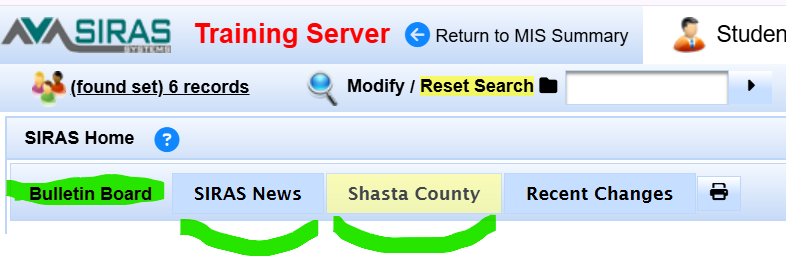
The Bulletin Board is used for SIRAS, SELPA, and district-wide information.
Home Page Tabs
Below the Bulletin Board are Home Page tabs for Student Data Overview, Meetings, Incoming Messages, and—depending on your permissions—transfer and assignment requests. Some tabs may be collapsed to save space. A + indicates that the section can be expanded.

Select a tab header or + to expand a collapsed Home Page section.
A general provider, school-level user, district administrator, and SELPA user may see different populations and administrative tabs. Use Home as a starting point, but do not assume every task for your role appears there.
Student Data Overview
Student Data Overview summarizes meeting and compliance signals for the records available to you. Depending on access and scope, the population may represent a SELPA, district, school, or a provider's assigned students.
Current Meeting Alerts
The meeting-alert links and graphical wheel highlight populations such as Pending Referrals and upcoming or overdue Annual/Triennial work. Selecting an alert places the matching students into the Choose Student list so you can review the actual records.

Select an alert population to open the matching students in Choose Student.
Treat that as a signal to review the record first. Prior Annual, evaluation, or inherited-plan history may be missing. Do not create a new meeting merely to make the overdue indicator disappear. See Getting Started for Providers — Verify Record Readiness.
Compliance Health
The Compliance Health gauge summarizes the compliance indicators available for the selected population. It may include Initial Evaluation timelines, third-birthday timelines, transition-regulation items, and Annual/Triennial meetings where the actual meeting exceeded the applicable deadline.
Below the gauge, users with broader scope may see district or school summaries ranked by compliance percentage. Selecting a district/school or its number link can narrow the view or open the affected student population for review.

Compliance Health summarizes compliance concerns within the user's available scope.
For the broader LEA monitoring workflow, see LEA Data Monitoring Tasks. Providers normally use Home to manage their own assigned workload rather than the LEA-wide reporting cycle.
Meetings
The Meetings tab helps users find and organize meeting work already represented in SIRAS.
Choose Meeting List
Select Choose Meeting List to view the available predefined meeting views/queries.
The magnifying-glass control  can place the students represented by the Meetings tab into your current Found Set.

Use the Meetings tab to narrow and sort meeting work.
Providers can use the sorting/filtering controls to focus on their assigned students when that option is available. Review meetings already in progress before creating another event for the same student.
- Open an existing meeting that is already in progress instead of creating a duplicate.
- Review meetings marked Held that still need parent-response, documentation, or finalization work.
- Use meeting-related predefined queries when you need an event-driven population that is not obvious from the Home summary—for example, an open meeting whose Assessment Plan has been received.
See Meeting Reports Help, Predefined Queries & Lists, and Getting Started for Providers.

Review existing meeting work and completion status regularly.
Transfer Request — Student Records
Administrators may see the Requested Transfer List for student records.
When a student enrolls in another SIRAS district after leaving your district, the receiving district or its SIS may request the current record. The sending district reviews the request and resolves it using the available transfer controls.
- Send transfers the current record to the receiving district.
- Cancel denies the request; document the reason and follow local communication procedures.
- Allow Preview may be used when the workflow allows the receiving district to review the record before transfer.
Once the current record is transferred, the former district no longer owns the Current record, but historical archived records remain available through the applicable historical searches.
See Request Student Transfer Help.

Administrators use the Transfer Request tab to resolve incoming requests for student records.
Caseload Assignment
CALPADS Clerk / District Admin 1 users may approve or cancel requests to add or remove students from provider caseloads. When the request is resolved, SIRAS updates the provider assignment and sends the requesting provider a SIRAS message.
See Manage Caseload Help.

Authorized staff approve or cancel provider caseload-assignment requests.
User Transfer
Administrators may view, approve, or deny requests to move an existing SIRAS user account from one district to another.
Before approving a known staff transfer, confirm that student assignments from the former district have been cleared or reassigned as appropriate.
If you do not recognize the request, contact [email protected] rather than approving an uncertain user transfer.
See User Account Transfer Request Process.

Authorized administrators review requests to transfer an existing SIRAS user account between districts.
Incoming Messages
Incoming Messages are part of the daily SIRAS work queue. Review them routinely because SIRAS uses messages to tell users when an action or request has changed.
Examples include:
- a link recipient signed a form;
- a student was added to or removed from your caseload;
- an IEP translation was completed; and
- other system, assignment, transfer, or workflow notices.
Messages can be archived or deleted after they are no longer needed. In other parts of SIRAS, selecting a user's name may also allow you to send a SIRAS message to that user.

Providers should review Incoming Messages for assignment changes, signed forms, translations, and other workflow activity.
For broader messaging behavior, see SIRAS Communications.
How Home Fits Into the Provider Work Cycle
Home is the provider's starting point, not the entire workflow. A practical recurring pattern is:
| Provider question | Home / SIRAS starting point | Then |
|---|---|---|
| What changed since I last logged in? | Incoming Messages | Open the student, form, request, or task that now needs attention. |
| Is my caseload correct? | Incoming Messages + current assigned students | Use Manage Caseload Help when an addition/removal is needed. |
| What work is coming? | Student Data Overview | Review the actual student record and prepare early enough for local timelines. |
| Do I already have a meeting open? | Meetings tab | Continue the existing meeting rather than creating duplicate history. |
| This record looks overdue or incomplete. What now? | Student Data Overview / student record | Verify record readiness before creating a new meeting. |
| Has an important meeting-related event happened? | Home + Predefined Queries | Use the applicable Meeting Related query, such as an open meeting with an Assessment Plan received. |
Continue with Getting Started for Providers for the provider work cycle and Provider Support for task-based help.

